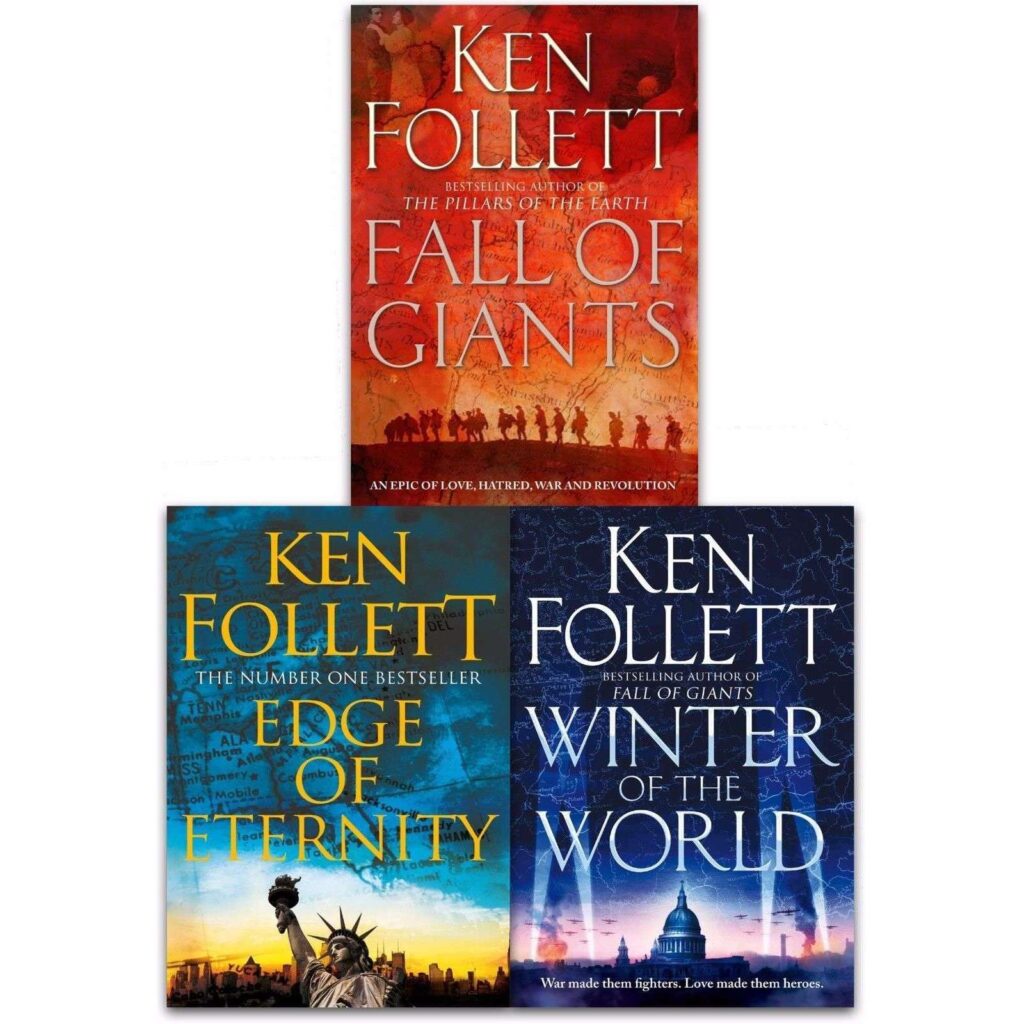
Another world-and-decades sweeping trilogy by Ken Follett, he of The Pillars of the Earth and all its follow-ons, and this one is just as epic and sweeping and big as those. It begins shortly before WW1 and ends in the 1980s.
1. Fall of Giants- this is the first novel of the trilogy and introduces the five families we will be following over the next 90 years or so:
A. The Williams family. Welsh miners with the youngest son, 13 year old Billy, starting his first day in the coal mines as his sister, Elie, gains promotion in the household of:
B. The Fitzherbert family- the lords of the town of Aberowen where the Wiliiams’ live and work, Earl Fitz, as he is called, owns the coal mine and he is every insufferable English aristocrat you can imagine. His sister, the Lady Maude, is as maverick as the upper crust was allowed to be, with her indulgence in suffrage and charity works. Fitz’s wife, Lady Bea, is a Russian princess.
C. Peshkov family- Grigori and Lev, peasant brothers in Petrograde who witnessed Lady Bea’s father hang their father for grazing his cattle on her family’s land. So they’re not big fans of the princess.
D. Von Uhlrich family. From Berlin, Walter, who is a schoolmate of Earl Fitz and has a thing for Maude, and his cousin, Robert, who would probably have a thing for Fitz if such a thing was allowed.
E. Dewar family. Americans from Buffalo, Gus is also friends with Fitz and von Ulrich and is a personal assistant to President Woodrow Wilson.
So basically you have every cardboard character you need in all the right places to explore the events of WW1 and afterwards. And we do. And I don’t mean to be dismissive of the characters, I actually like them, but they are constructed as vehicles for the events. You get to see WW1 and its aftermath through the eyes of what most of us consider the typical checklisted persons: the rich heiress who defies her stuffy family and embraces the new cool things; the downtrodden servant abused by the master but rises through her pluckiness into a position of independence; the Russian peasant boys who become a gangster and a Bolshevik, respectively. How else are you going to follow the action unless you’re right in the middle of it?
And it’s great action, from storming the trenches at the Somme to the storming of the Winter Palace. Follet highlights some important events of the time that don’t get a lot of attention, like the Zimmerman telegram and the German funding of the Bolshevik Revolution, from perspectives of direct participants. It’s really good. Some points not considered come up, too, like, what do you do after successfully overthrowing the government? What do you do after losing a war? We get to see what to do, and it ain’t pretty.
Definitely kept my attention and made me care enough about these five families that I picked up volume two,
2. Winter of the World:
This one covers the pre and some of the post WW2 years: Moscow and the Bulge and everyone trying to eliminate everyone else for one ideological reason or another. The children of the families are the focus during this time frame:
A. The Williams family. Lloyd Williams, Earl Fitzherbert’s illegitimate son with the former maid and now activist Ellie, becomes a trade unionist and fights for the Republican side during the Spanish Civil War, where he has first-hand encounters not only with the Nazis but the equally brutal Soviets. He later becomes an OSS agent helping downed flyers escape France.
B. The Peshkov family. Daisy Peshkov is the spoiled brat ingenue daughter of Lev and Olga who has probably the oddest character arc in the book, going from snob to labor activist, ending up marrying Lloyd after her husband, Boy Fitzherbert (who is Lloyd’s half brother) dies at Lloyd’s feet in a rather incredulous manner.
Greg Peshkov is Daisy’s half-brother … lots of halves going on between these families … who works on the Manhattan Project and fathers a half-black child with aspiring actress, Jacky Jakes, who Greg’s father, Lev, basically paid to be his lover when he was 16. This might have some impact on Greg’s future plans to run for office.
Vladimir Peshkov, the son that Lev left behind in Russia in the care of his brother, Grigori, becomes a member of the GRU and helps steal Manhattan Project plans.
C. The von Uhlrich family. Werner and the Lady Maude suffer tremendously in Berlin, especially when Werner falls afoul of the Gestapo. Their daughter, Carla, pays one, too, when she interferes with several Russian soldiers attacking a Jewish teenager, Rebecca, who the von Ulrich’s later adopt. Eric von Ulrich remains a fanatical Nazi until he runs into an Einsatzgruppen massacre of Jewish civilians, probably at Baba Yar. He then becomes a fanatical Communist.
D. The Dewar family. Still involved with politics, Senator Gus Dewar’s son, Woody, is an aide who assists with the Atlantic conference but joins the airborne after his fiancee dies during the attack on Pearl Harbor. His brother, Chuck, is a quasi-closeted gay man who everyone knows is gay and who serves during the battle of Midway and dies at Bougainville protecting his lover, Eddie.
As in the first book, these are conveniently cardboard characters used to depict the main events and even some side ones like the Nazi program to murder handicapped people, which Carla has a hand in ending. And practically the entire Dewar family is at Pearl Harbor on Dec 6, so I wonder what they’re going to witness? But, still, quite fascinating and an excellent read.
Which brings us to:
3. Edge of Eternity: from the end of WW2 through the Fall of the Berlin Wall, the boomer kids of the families now take center stage:
A. The Williams family: Dave Williams, the son of Daisy and Lloyd, becomes the founding member of a British invasion band called Plum Nellie, with all the shenanigans of the burgeoning record industry.
B. The Fitzherbert family- pretty much switches away from Daisy and Lloyd’s story when Dave is born and becomes a rock star.
C. The Peshkov family- they’re all over the place. Dmitri Dvorkin is Grigori’s grandson and quite a brutal apparatchik working for Kruschev who gets involved with Gorbachev’s rise to power when he becomes disillusioned with Communism. His sister, Tanya, is a journalist smuggling subversive novels, a la Solzhenitsyn, out of the Soviet Union.
George Jakes, the half-black son of Greg, is in the middle of the civil rights movement, becoming a Freedom Rider, a witness to the King and Bobby Kennedy assassinations, and a congressman.
D. Von Ulrich family. Caught behind the Iron Curtain, the family is branded subversive when a Stasi agent named Hans Hoffman induces Rebecca to marry him and spends the rest of the book finding unique and cruel ways to torture everyone after Rebecca escapes to the West. Rebecca’s brother, Walli, also escapes by crashing a truck through a guard post, killing an East German border guard and ends up in Dave’s band, Plum Nellie, where he and Dave re-create the Paul McCartney, John Lennon dynamic.
E. Dewar family- Cameron Dewar is the only conservative student at Berkeley and joins the Nixon campaign, and in some of the resultant shenanigans.
Lots of other people related one way or the other to a character or two show up where necessary, such as Jasper Murray, son of Daisy’s friend, Eva, a scurrilous journalist who, as an American green card holder, is drafted and spends a year in Vietnam doing scurrilous things. This is so Follett could squeeze Vietnam in among the hundreds of other boomer events across the decades, including the Prague Spring, the Cuban Missile Crisis, Watergate, and the March on Washington. All seminal events, for those of you, like me, who were around to see all this.
But I was a little puzzled by big things that weren’t included, like the moon landing, the gas crisis and the Iranian hostages, which were sort of big things, too. I get that, when you are dealing with such a complicated time period you have to be selective or your 1000 page novel will easily get to 2000, but it seems something else was going on in this one, and that’s Follett’s obvious left-leaning bias. Seems it was all Gorbachev’s ingenious plan to modernize Russia that brought the wall down, not Reagan or Star Wars or any request to tear down this wall. Nope. Nothing to do with it.
Which is fine. You pays your money you takes your chances. And while I would not consider this anything more than bumper sticker history, I liked the characters, I liked following their arc and seeing what happened with them. If you can ignore the politics, you will, too.
Must point out that there is a lot of sex in this. A lot. Including a rather detailed and graphic affair between a black secretary and President Kennedy. I’m guessing Follett was quite assured he had the research and evidence to avoid a libel suit. And it’s fairly descriptive sex, so be ready. Which makes sense. After all, it was the sexual revolution.